Center for Strong Public Schools logo

close the

achievement gap

We believe all students, no matter their background, can achieve academically. For too long, we’ve accepted the idea that students won’t attend school consistently or learn on grade level. That has to change. We must close the achievement gap, so every student reads and does math on grade level. Right now, only about 2 in 5 students are proficient in 4th grade English Language Arts on DC CAPE, and just 1 in 4 students are proficient in 4th grade math. When students are not on grade level, they are locked out of future opportunities in life, college, and career.

2 IN 5

students proficient in 4th grade ELA on DC CAPE

1 in 4

students proficient in 4th grade math

reading is a right

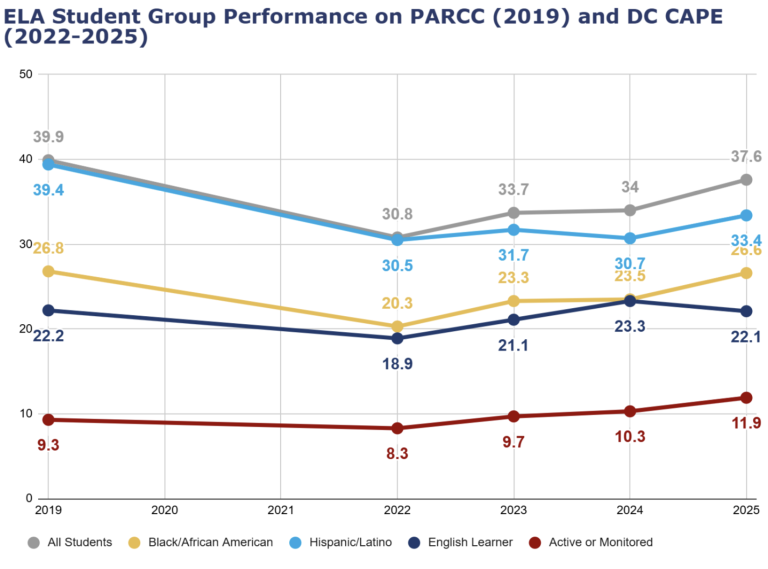
We believe that every student has a right to read. While we are proud to see progress in English Language Arts (ELA) proficiency from year to year since the 2019 pandemic levels, the promise of childhood literacy remains unmet.

%

of D.C. students met or exceeded expectations in English Language Arts (ELA) proficiency on the DC CAPE in the 2024-25 school year, with wide gaps between student groups.

This is not reflective of what we know D.C. students can achieve.

D.C. must strengthen how reading is taught

(and it cannot take a decade)

Every year that we wait to do what works, we leave more children behind. How do we ensure childhood literacy? We must implement the science of reading.

what

A robust body of research on how children learn to read and what instructional practices are most effective. Structured literacy training specifically equips teachers with proven, research-based methods for explicitly and systematically teaching reading, especially foundational skills such as phonemic awareness, phonics, fluency, vocabulary, and comprehension.

why

Unlike speaking, which develops naturally, reading must be taught explicitly. The brain is not wired to connect sounds to symbols on its own, which is why students need systematic, structured instruction to become proficient readers.

It also ensures teachers can reach all learners, including students with dyslexia and other learning differences, rather than relying on approaches that only work for some students. Without this training, too many students fall through the cracks.

who

About 40 states have enacted legislation aimed at improving reading instruction. D.C. is no different. In 2022, the D.C. Council passed and the Mayor approved the Structured Literacy Action Plan Act, which established an Early Literacy Education Task Force.

The Solution

We need a bold commitment from the Mayor and DC Council to fully implement the Early Literacy Education Task Force recommendations. This Task Force produced four core recommendations that have largely gone unimplemented:
Require structured literacy competency for key educators, including K–5 teachers, reading specialists, special education teachers, and English learner teachers.
Require structured literacy training for school leaders, including principals, instructional coaches, and those who support or evaluate teachers.
Provide ongoing, job-embedded support by developing a classroom walkthrough tool and piloting direct coaching for educators.
Increase transparency and quality of curriculum by collecting and publishing ELA instructional materials and creating a vetted list of high-quality, science-of-reading-aligned resources.

anyone can be a math person

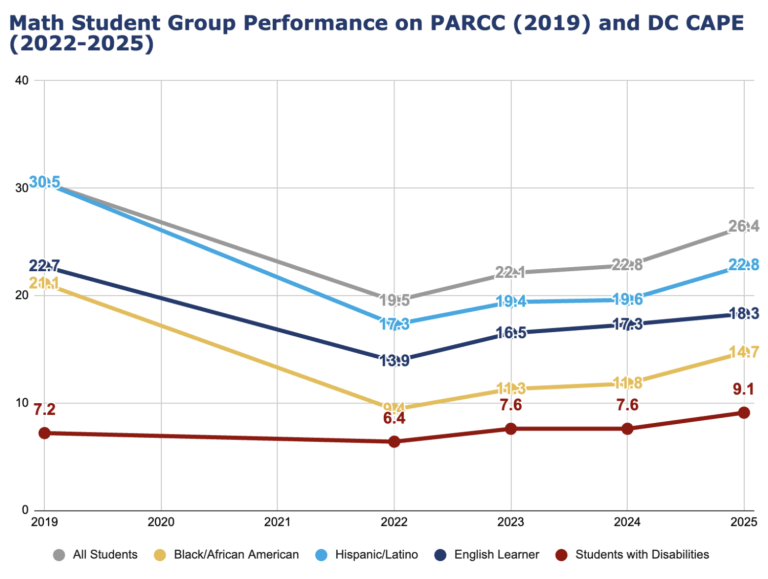
We believe anyone can be a math person. While D.C. is rebounding from pandemic-era learning loss, progress remains too slow for our students.

d.c has a math problem

%

of D.C. students met or exceeded expectations in Mathematics proficiency on the DC CAPE in the 2024-25 school year, with wide gaps between student groups.

why does this matter

Math proficiency supports lifelong success from early learning to civic participation by helping students navigate information, problem-solve, and think critically.

When students receive a strong math foundation, it opens doors to future economic mobility, career options, and long-term opportunities for students, families, and communities. Studies show that students are more likely to have postsecondary success when they pass Algebra I by the eighth grade.

The Solution

Consistency and coherence across classrooms create fairness and stability for students and educators, no matter what school they attend. We need a bold commitment from the Mayor and D.C. Council to fully implement the seven recommendations of the Math Task Force:
High-quality instructional materials: All LEAs select, adopt, and implement high-quality instructional materials for grades K–8 and all math courses required for graduation.
Professional learning – evidence-based math instruction: All math educators demonstrate competency in evidence-based math instruction.
Professional learning – content knowledge: Educators demonstrate competency in grade-level math content, especially in grades K–8 and graduation-required courses.
Professional learning – educator support: Develop tools like non-evaluative observation and pilot a math instructional leader cohort to support teachers.
Diagnostic assessment and intervention: Provide tools to align math interventions with core instruction so students get the right support.
Family and community engagement: Engage families on math learning, student progress, and building a growth mindset around math.
Integrated math pathways: Explore the benefits and tradeoffs of adopting an integrated math pathway for high school students.
2025 © Center for Strong Public Schools. All Rights Reserved.
Center for Strong Public Schools is a 501(c)(3) nonprofit organization. We do not endorse or oppose any candidates for public office. Contributions are tax-deductible to the fullest extent allowed by law.