
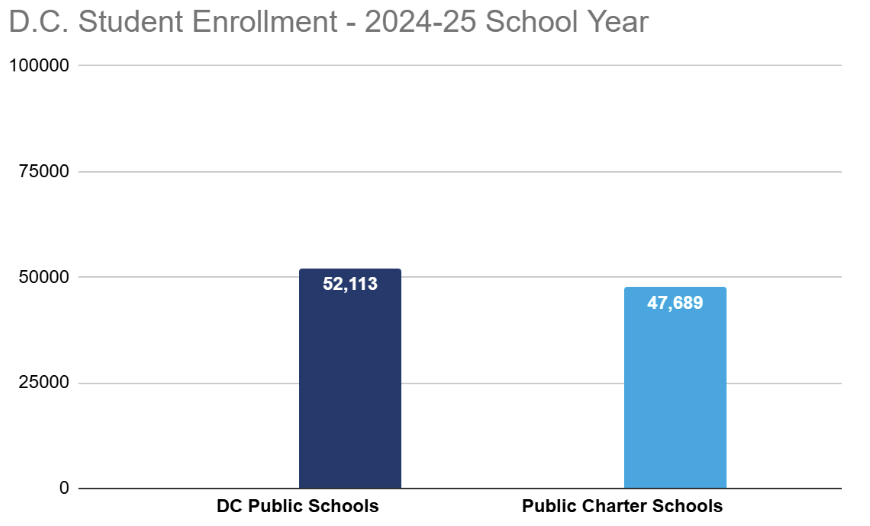
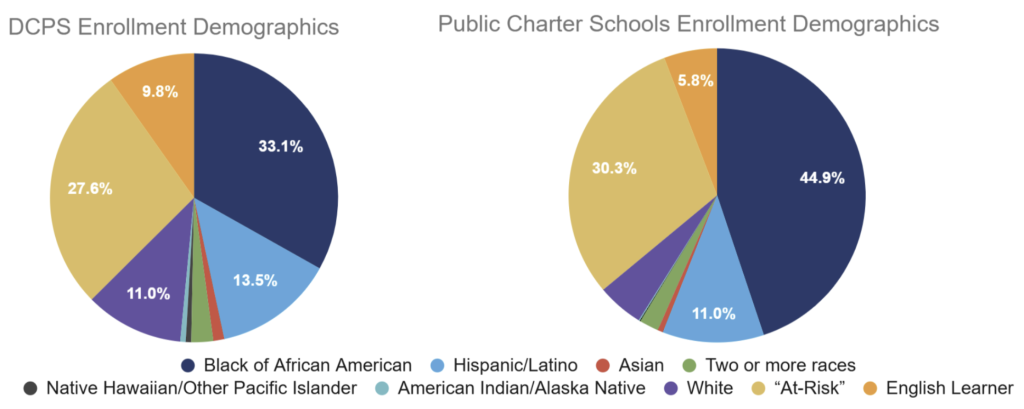
The Uniform Per Student Funding Formula (UPSFF) in Washington, D.C. was created in 2008 to establish a student-based funding system that allocates funding to DCPS and public charter schools based on student needs and characteristics. D.C’s UPSFF is one of the most equitable in the nation. Despite their roughly equal enrollment, there is a funding gap between DCPS and public charter schools in D.C.
For the FY27 budget, Mayor Bowser proposed a 2.55% UPSFF foundation level funding, an equivalent of $15,455 per student to be allocated to both sectors in one pot of funding. This funding includes educator pay increases from the Washington Teachers Union agreement. At the same time, the Mayor transferred $96 million outside of the formula to the Department of General Services, thereby denying public charter school students equal access to comparable funding for similar services. She then compounds that inequity by flat-funding at $187.3 million the charter facilities allowance (through 2030), while raising DCPS capital funding to $555.9 million.
If passed, DCPS would receive roughly $2,000 more per student in operating funds than public charter schools. When factoring in facilities funding and capital investments, the total funding gap grows to nearly $9,675 per student.
These fixed costs are for rentals, water, sustainable energy, electricity, waste, and gas. This means that this funding will live outside of the UPSFF and will be accessed by DCPS only. Public charter schools will receive $0 even though they have the same requirement to ensure the health and safety of their students as DCPS.
Early Stages, while a DCPS line item, is meant to serve all children ages 3-5 years old who may have developmental delays or disabilities. Both sectors have a duty to support these students but the funding only flows to the traditional public school system.
DCPS receives $25.5 million for IMPACT teacher bonuses, while charter schools are shut out of this funding and unable to offer comparable incentives. With teacher retention being a top issue for policymakers, this sends the wrong message.
Well-maintained buildings are vital to the health and safety of students, educators, and school staff. For both sectors, facilities are a major, unavoidable cost. DCPS is projected to receive $559.9 million in capital funding for FY2027 alone for school modernizations and major upgrades. Unlike DCPS, which receives direct capital funding from D.C. with access to the Department of General Services to manage their buildings, charters rely on the charter facilities allowance of $187 million to help cover the cost of buildings, including rent, mortgages, and maintenance. This year, the Mayor did not provide a 3.1% increase for inflation. The allowance does not fully cover actual costs and facility costs sometimes outpace the 3.1% adjustment.
| DCPS | PCS | |
| Fixed Costs | $59.4M | $0 |
| Early Stages | $11M | $0 |
| Teacher Bonuses | $25.5M | $0 |
| Total Operating Funds outside the formula | $95.9M | $0 |
| Per Student difference | $2,000 more per student (based on FY27 proposed enrollment for 47,982) | |
| Per Student difference | DCPS receives $95.9M more operating dollars than PCS outside of the formula, which equals to $2,000 more per student (based on FY27 proposed enrollment for 47,982) | |
| DCPS | PCS | |
| Facilities Funding | $555.9 (capital dollars) | $187M (charter facilities allowance) |
| Per Student Difference | DCPS received $465M more than PCS outside of the formula, which equals to $9,691 per student (based on FY27 proposed enrollment for 47,982) | |